Monday, October 24, 2016

Cherry Creek Falls Duvall


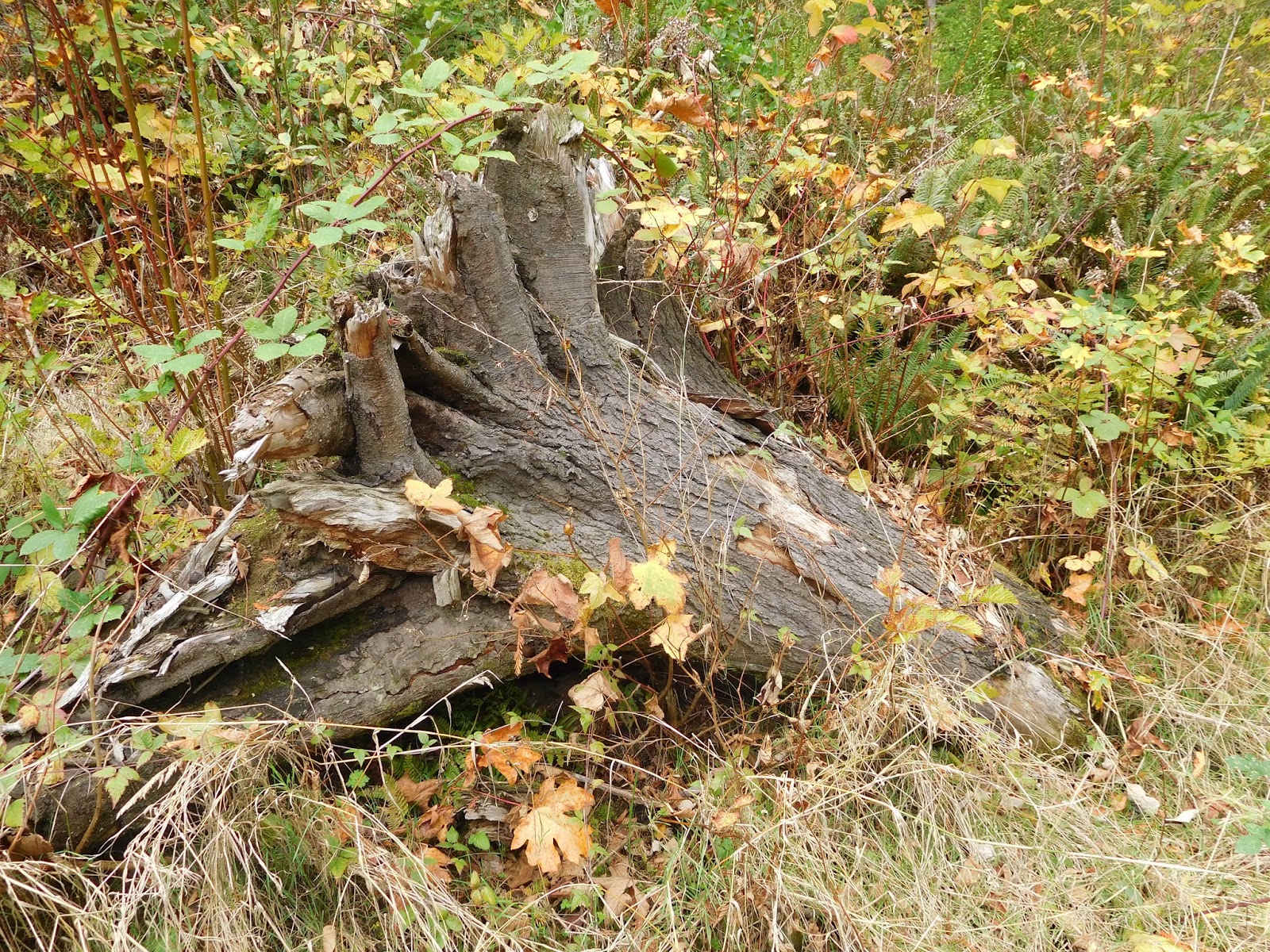
I chose to do my research assignment on oregon grape.  This quadrant was located in Cherry Creek falls in Duvall/Carnation.  About a mile in on the main trail there is a wrecked car on the right side, and just a few feet ahead is a second trail which leads to this site.  The area has moss covered trees and the ground is very wet and muddy considering it hasn't rained for a few days.  Up the hill on the second trail, it begins as sword ferns, but about 15 feet up it becomes a mixture of sword ferns and oregon grape, and tapers off to just oregon grape.  The average between quadrants was six, with more further up the trail than near the bottom.

I'm not exactly sure why the oregon grape and sword fern were in distinct separate locations, but I have a few ideas.  One might be because of water usage and how water travels throughout this hillside, which might explain why ferns were mostly at the bottom of the hill. Sword ferns might not be as drought tolerant as oregon grape.  The other prospect could be because of light, which the bottom of the hill received more of.  I could see this technique being helpful with pin pointing what might cause a population to decline.  Different samples could be taken from separate areas, and habitat differences between the two may explain why one area has a thriving species while the other area(s) are lacking.  Quadrant samples could be different sizes as well depending on population density.


PNW mushroom population

I decided to do my survey in Hickman park in downtown Edmonds, At the time of this survey, it was between the hours of 5pm and 6pm. The weather was rainy.
This park is a very vast feature of downtown Edmonds, sprawling many acres, I decided to survey the mushroom, Galerina.
It is a medium sized mushroom at its full growth potential, and has a coloration of light brown to darker orange/brown with maturation. The average number of organisms across the site that I surveyed was 6.1. However, they were extremely clustered, 4 of the areas I surveyed were completely devoid of mushrooms, while the highest frequency site was at 21 mushrooms for the upper left hand quadrant.  The terrain that seemed to be the most susceptible to the Galerina mushroom that I was seeking was areas with shade, but still open enough to have enough rainfall. Along the gravel pathway, there were no mushrooms anywhere on or around it; as the area around it was water logged and had no decaying matter for the mushrooms to munch on. Also, while walking around the park, I noticed that the mushroom I was seeking, as well as any other fungi avoided high traffic areas such as the playground.


, The area of most interest, with the highest frequency of the mushroom, was under a medium sized rhododendron bush with large coniferous and broad leaf maple trees above it. Above the Rhodie, there were Douglas Firs, Golden Maple trees, and Western Red Cedar. The mushrooms seemed to prefer areas that had a ton of decomposing matter in which to munch on, areas where the sunlight was not a hindrance, but at the same time acquired enough rainfall to sustain themselves. In the area surrounding the highest-frequency of mushrooms, large maple leaves, a few dead logs, and other organic matter were decomposing, providing a perfect diet for my little fungal friend. The fungi also seemed to avoid ground dwelling organisms such as ivy. The fungi preferred areas of shade, but also with areas that still have a significa nt amount of rainfall, but not to the point of being soppy in nature. They love decomposing matter, and seem to avoid ground dwelling plants such as ivy and ferns, The only thing that hindered my attempt at this survey was the fact that it was pouring down rain, my notebook was soaked. Also, a few patrons of the area looked at me as if I was insane, because of my circular device by which to analyze my quarry, I used three disassembled coat hangers...so, I guess I made my own bed, har har.

PNW mushroom population

I decided to do my survey in Hickman park in downtown Edmonds, At the time of this survey, it was between the hours of 5pm and 6pm. The weather was rainy.
This park is a very vast feature of downtown Edmonds, sprawling many acres, I decided to survey the mushroom, Galerina.
It is a medium sized mushroom at its full growth potential, and has a coloration of light brown to darker orange/brown with maturation. The average number of organisms across the site that I surveyed was 6.1. However, they were extremely clustered, 4 of the areas I surveyed were completely devoid of mushrooms, while the highest frequency site was at 21 mushrooms for the upper left hand quadrant.  The terrain that seemed to be the most susceptible to the Galerina mushroom that I was seeking was areas with shade, but still open enough to have enough rainfall. Along the gravel pathway, there were no mushrooms anywhere on or around it; as the area around it was water logged and had no decaying matter for the mushrooms to munch on. Also, while walking around the park, I noticed that the mushroom I was seeking, as well as any other fungi avoided high traffic areas such as the playground.


, The area of most interest, with the highest frequency of the mushroom, was under a medium sized rhododendron bush with large coniferous and broad leaf maple trees above it. Above the Rhodie, there were Douglas Firs, Golden Maple trees, and Western Red Cedar. The mushrooms seemed to prefer areas that had a ton of decomposing matter in which to munch on, areas where the sunlight was not a hindrance, but at the same time acquired enough rainfall to sustain themselves. In the area surrounding the highest-frequency of mushrooms, large maple leaves, a few dead logs, and other organic matter were decomposing, providing a perfect diet for my little fungal friend. The fungi also seemed to avoid ground dwelling organisms such as ivy. The fungi preferred areas of shade, but also with areas that still have a significant amount of rainfall, but not to the point of being soppy in nature. They love decomposing matter, and seem to avoid ground dwelling plants such as ivy and ferns, The only thing that hindered my attempt at this survey was the fact that it was pouring down rain, my notebook was soaked.

PNW mushroom population

I decided to do my survey in Hickman park in downtown Edmonds, At the time of this survey, it was between the hours of 5pm and 6pm. The weather was rainy.
This park is a very vast feature of downtown Edmonds, sprawling many acres, I decided to survey the mushroom, Galerina.
It is a medium sized mushroom at its full growth potential, and has a coloration of light brown to darker orange/brown with maturation. The average number of organisms across the site that I surveyed was 6.1. However, they were extremely clustered, 4 of the areas I surveyed were completely devoid of mushrooms, while the highest frequency site was at 21 mushrooms for the upper left hand quadrant.  The terrain that seemed to be the most susceptible to the Galerina mushroom that I was seeking was areas with shade, but still open enough to have enough rainfall. Along the gravel pathway, there were no mushrooms anywhere on or around it; as the area around it was water logged and had no decaying matter for the mushrooms to munch on. Also, while walking around the park, I noticed that the mushroom I was seeking, as well as any other fungi avoided high traffic areas such as the playground.


, The area of most interest, with the highest frequency of the mushroom, was under a medium sized rhododendron bush with large coniferous and broad leaf maple trees above it. Above the Rhodie, there were Douglas Firs, Golden Maple trees, and Western Red Cedar. The mushrooms seemed to prefer areas that had a ton of decomposing matter in which to munch on, areas where the sunlight was not a hindrance, but at the same time acquired enough rainfall to sustain themselves. In the area surrounding the highest-frequency of mushrooms, large maple leaves, a few dead logs, and other organic matter were decomposing, providing a perfect diet for my little fungal friend. The fungi also seemed to avoid ground dwelling organisms such as ivy. The fungi preferred areas of shade, but also with areas that still have a significant amount of rainfall, but not to the point of being soppy in nature. They love decomposing matter, and seem to avoid ground dwelling plants such as ivy and ferns, The only thing that hindered my attempt at this survey was the fact that it was pouring down rain, my notebook was soaked.

Pyrrharctia isabella, North of Glacier Peak High School

Pyrrharctia isabella

The Wooly Bear

The forest north of Glacier Peak High School was my chosen location. It is primarily a hilly area, sloping down toward the Snohomish River Valley, with lots of undulating terrain covered in rotting pine needles, maple leaves, logs, sword and bracken ferns, mushrooms, and various shrub species. The taller trees were those you generally find around Washington: Red Cedar, Dougles Fir, Hemlock, and lots of Maple. An access road for the forest service and sewer maintenance runs down the south side of the portion of forest I explored, and it was enclosed on either side by the invasive Himalayan blackberry, the small shrub species, young conifers, young Alder, and grass. There are many fallen trees and tree stumps that are nourishing new life, and the ground is downright squishy with water and rotting plant matter, but I did not see any active or dry streams. There were very few rocks or boulders in the area I surveyed. One interesting thing I found was an apparently abandoned tree fort that someone was building, complete with tools lying where they were last left, and several trees hewn down to form posts for the platforms. I also found a dead rat covered in flies, but no other animal life besides insects.
This is the access road where I conducted my survey of Wooly Bears. 

A rotting log

A mushroom feasting on maple leaves.


A tree feasting on a rotting stump
Unfinished Fort
Tree they chopped down

 Dead Rat
Mushroom and fern


For my population study, I chose Wooly Bear Caterpillars. I found a total of three Wooly Bears across the 12 quadrants, which were separated by ten steps each. On average, there were .25 caterpillars per quadrant. Quadrats 1, 3, and 10 had one Wooly Bear each. This transect may not be entirely representative of the site because the terrain was so uneven and difficult off of the access road, that doing a straight transect inside the woods would be significantly harder, though it may yield more Wooly Bears. This sampling tells us that Wooly Bears are more commonly found at the beginning of the transect, which started slightly farther into the woods. I would say this is a single population of Wooly Bears, because they are tiny little animals, and they do move. I am unable to determine if terrain altered the distribution of Wooly Bears; they were all found on the access road, which had little variation. I noticed while I was doing the transects that one or two Wooly Bears were to the sides of where I had to put my quadrat to make a straight line, and I had to desperately resist moving the quadrat or Wooly Bear to alter the results.
If surveys like this were conducted in an area, and the various habitats and terrain types within the area were able to be factored in to an estimate for the species population, this could be a very effective way of estimating populations of creatures without having to go out and manually count a thousand Wooly Bears. For threatened and endangered species, with even stricter necessary habitats than your average caterpillar, if we know that an ecosystem is capable of hosting __ number of an endangered species, we can estimate how many there might be, and alter our assessment and recovery efforts accordingly.

Pioneer Park, Lynnwood, Wa

Pioneer Park. Lynnwood ,WA

Top View Map of Site
This park has a small wetland trail that is about 1/4 of a mile canopied by various trees which include the Douglas-Fir (Pseudotsuga mensiesii), Western Red cedar (Thuja Plicata), Red Alder (Alnus Rubra), Douglas Maple (Acer Glabrum). There were around 4 trees that were dead, some looked like they have fallen while a few others, stump's looked at though they were hosting termites. Off to the left there was a gated wet land that looks very swampy. Ferns, mosses, and Ivy covered the ground in areas along the trail. The trail had man-made wooden stairs. The trail was covered from debris of Douglas Maple leaves and Samara fruit, and branches and Pine cones from the Douglas-Fir and Red cedar.
Groupings of prominent findings in the
majority of the quadrants

I chose cones from the Douglas Firs, they cover the floor among other debris from the trees. They are mostly scattered through out the trail. There were many other parts of organisms in my quadrants. At the start of the trail there were as many as 1-5 cones but as I went further on to the trail there began to be closer to 11-15 cones in one quadrant. The reason for this could be from the cones falling and rolling down hill, and them getting kicked around from human contact. There was a uneven terrain, the trail had a large hill on the right side of the trail. Just by focusing on one species you can gather where they may have came from and why the may have ended up where they were. On a bigger surveying map this could help to determine where species are living and where they are non-existent and definitely could be useful in determining if a species are threatened in anyway.

Survey of Local Mushroom Population

I decided to do an organism survey of a species of mushroom located at the Veterans Memorial Park in Mountlake Terrace. The area is made up of wet grass, moss, taller grass and shrubs, various evergreen plants, and conifers and douglas firs. Across the middle of the grassy clearing in the middle of the park is several species of mushrooms. The area is fairly well shaded with lots of moisture from a nearby stream. Many of the mushrooms were growing in the wettest areas of the grass next to moss, and there was also lots of mushrooms near an old stump. Very few of the mushrooms were located near the trees surrounded by dirt. The only issues with doing sampling in this area were all the fallen branches and sticks to trip over, and the occasional person playing with their dog.

There was many interesting mushrooms growing at the park, but the most widely spread species was a small, brown mushroom that was growing in clumps all across the grass. I spent a lot of time trying to identify the exact species, but as it turns out "little brown mushrooms" or LBM's grow in abundance, so identification is a little fuzzy. I would say the species I was sampling was likely some type of Conocybe.

Across my transect there was a total of 236 of these Conocybe mushrooms. The average amount per quadrant was 19.66. The largest clump of 36 was growing in a very wet patch of grass between the old stump and fallen tree. The smallest clump, a single lonesome mushroom, was growing closest to the park near some of the dry dirt near the trees. Many of the clumps seemed to be separated from each other by 3-7 feet of space, sometimes with 1-2 lonesome mushrooms growing in between them. It was interesting to see how far apart the clumps were from each other, especially when the mushrooms located in a clump were growing very close together.


The habitat and terrain seemed to play a big part in where the mushrooms were located. Most of them seemed to prefer the wettest areas in the middle of the grass. Very few were located nearest to the cement paths, with the smallest amounts being near the picnic area and playground. I also noticed that another species of whiter, larger mushroom was growing in a little line. None of the little brown mushrooms that I was doing a survey of seemed to grow near this other species, but were alright with growing near other types in the park. It's likely that this other species was hogging the resources and nutrients of the area it occupied.


 I can definitely see how a population survey like this can be used to assess the distribution of other species and populations. From my survey, I was able to see that the mushrooms did not prefer the environment closest to the playground and cement areas. If this species of mushroom were endangered, I would be able to assume that the mushrooms needed a certain type of habitat to thrive, and would be able to help them by protecting their favorite habitat to grow in. This kind of information is useful to people trying to help endangered species by using the information gathered to protect the habitat that they do best in.